
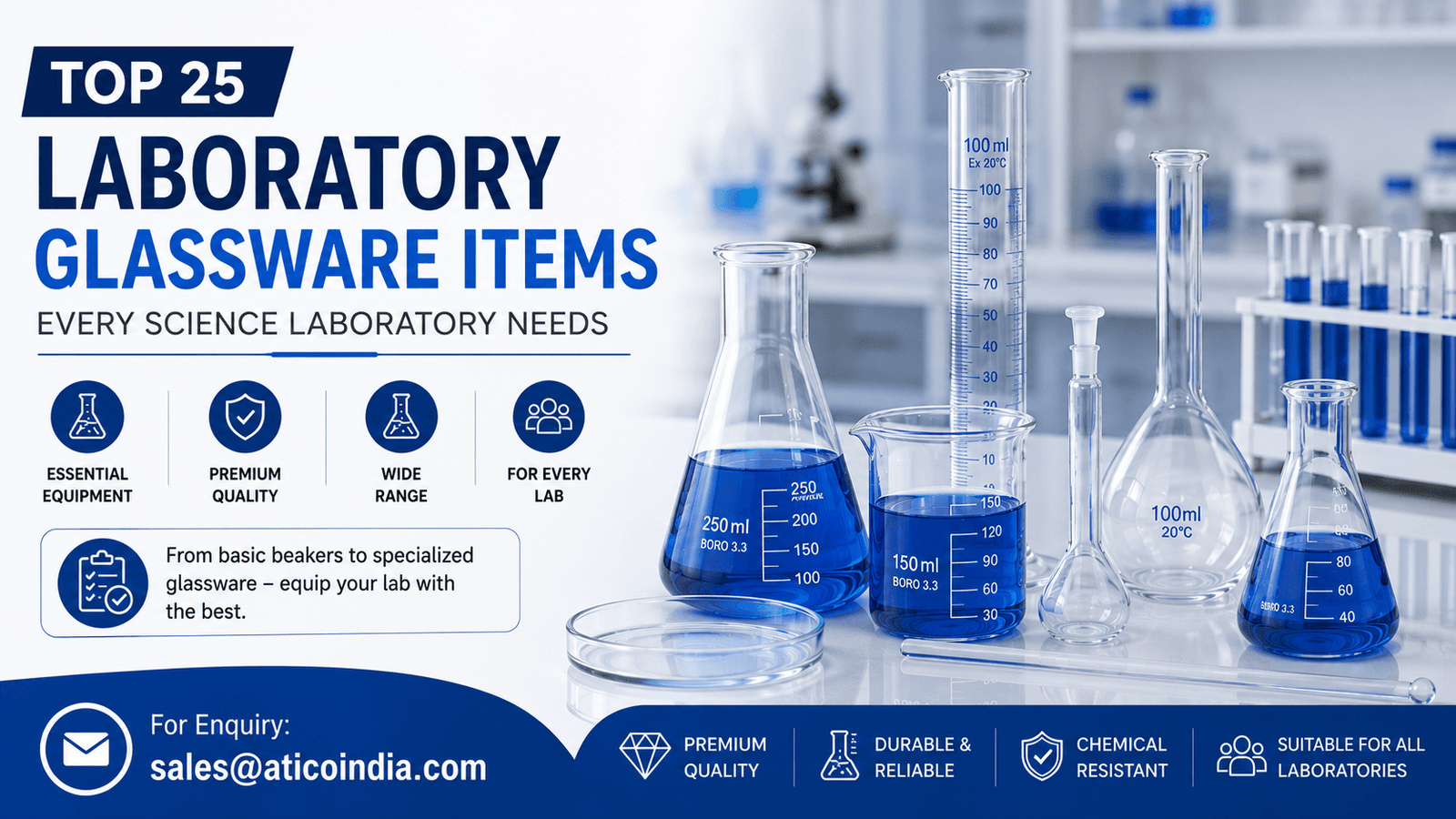
Every functional science laboratory — whether in a school, university, research institution, or industrial facility — is built on a core inventory of glassware. Some items are obvious (beakers, flasks). Others are quietly essential and routinely forgotten until an experiment stalls for want of a single adapter. This guide lists the 25 laboratory glassware items that form the backbone of a working lab, what each is used for, and what to check before ordering.
Request the Complete Laboratory Equipment Catalogue →
Why a Complete Glassware List Matters Before You Order
Most laboratory setups fail not because the expensive equipment is wrong, but because the inventory is incomplete. A lab can have a microscope and a fume hood and still be unable to run a basic titration because nobody ordered enough burettes, or the right joint adapters. Working from a complete list — rather than assembling piecemeal — prevents the mid-setup gaps that delay a lab becoming operational. It also lets a procurement team consolidate a single bulk order from one laboratory glassware manufacturer rather than placing repeated small orders as gaps surface.
The 25 Essential Laboratory Glassware Items
Measurement & Volumetric Glassware
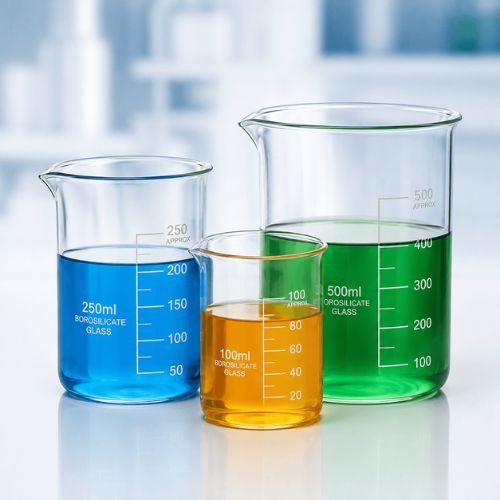
1. Beakers — General-purpose containers for mixing, heating, and holding liquids. The most-used item in any lab. Available across a wide capacity range. See beakers.
2. Conical (Erlenmeyer) Flasks — Narrow-necked flasks ideal for swirling liquids without spillage; standard for titration.
3. Volumetric Flasks — Precise single-volume flasks for preparing standard solutions. Class A for accuracy-critical work.
4. Graduated Cylinders — For measuring approximate liquid volumes quickly.
5. Burettes — Precise dispensing of variable volumes; essential for titration. See burettes.
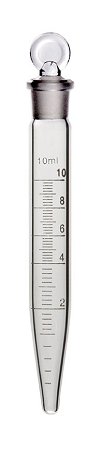
6. Pipettes (Volumetric & Graduated) — For transferring precise liquid volumes.
7. Measuring Flasks — For solution preparation at defined concentrations.
Heating & Reaction Glassware
8. Round-Bottom Flasks — For heating and reactions requiring even heat distribution.
9. Flat-Bottom Flasks — For reactions and storage where the flask must stand unsupported.
10. Distillation Flasks — Designed with a side-arm for distillation setups.
11. Condensers (Liebig, Allihn, Friedrichs) — For cooling and condensing vapor during distillation and reflux. See condensers.
12. Retort — Traditional distillation vessel, still used in specific applications.
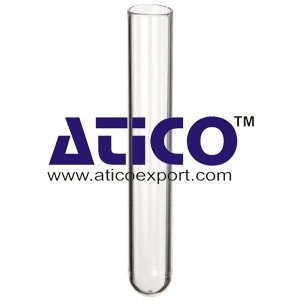
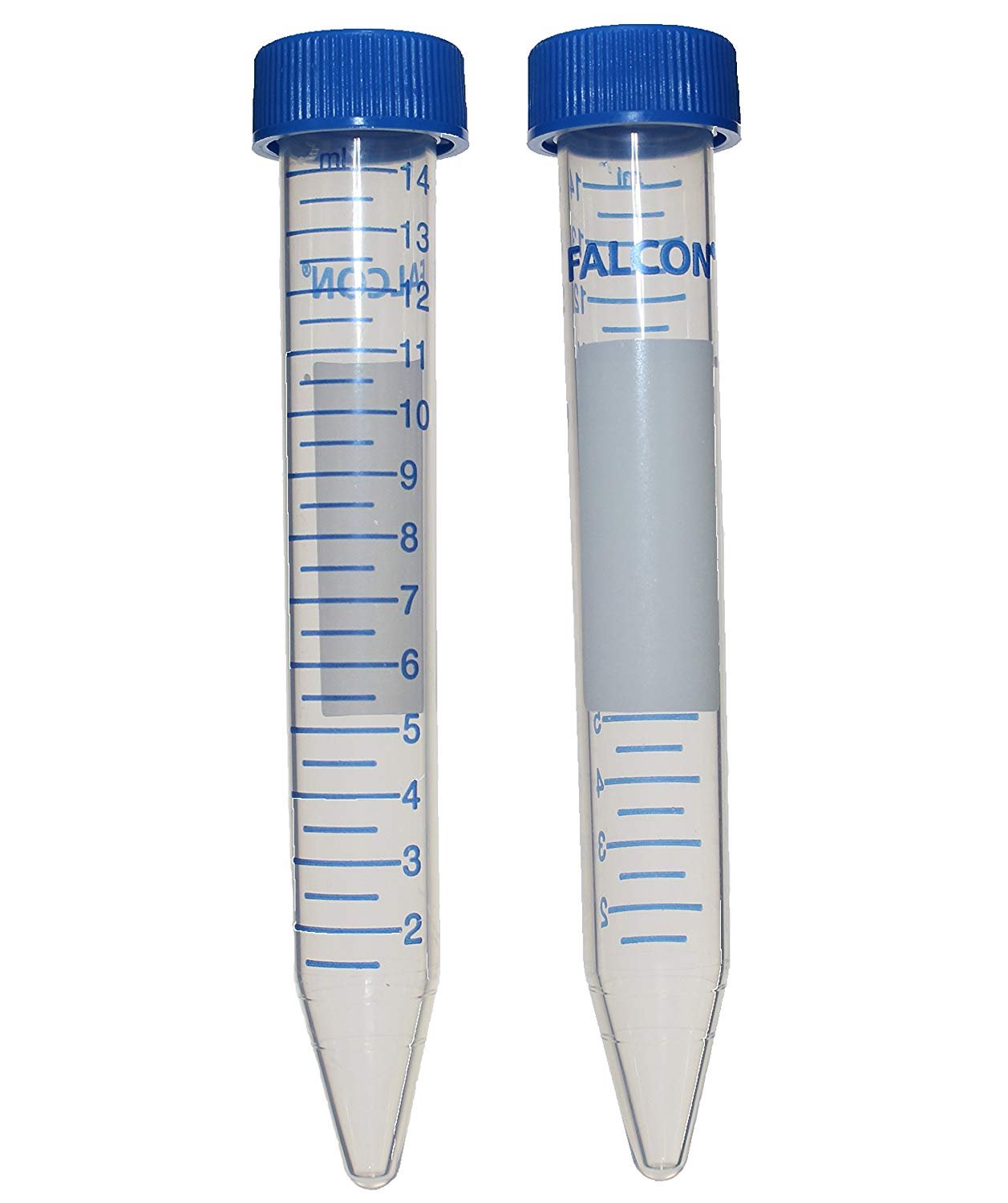
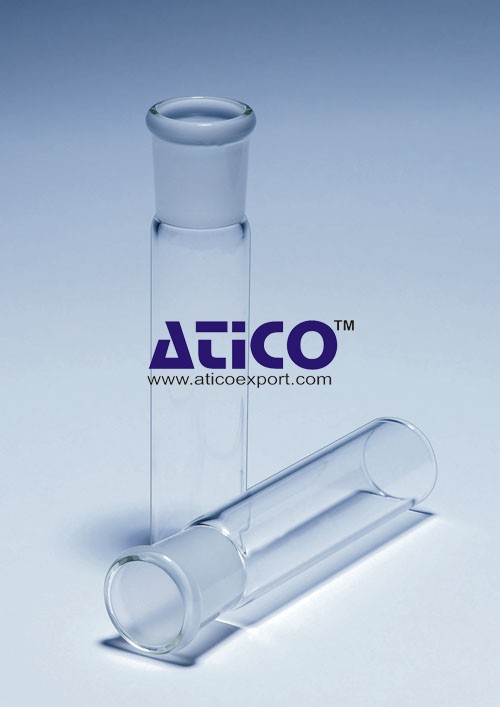
13. Test Tubes — For small-scale reactions and qualitative tests.
14. Boiling Tubes — Larger, sturdier test tubes for heating.
Separation & Filtration Glassware
15. Separating Funnels — For liquid-liquid extraction and phase separation.
16. Filter Funnels — For gravity filtration.
17. Büchner Funnels (with flask) — For vacuum filtration.
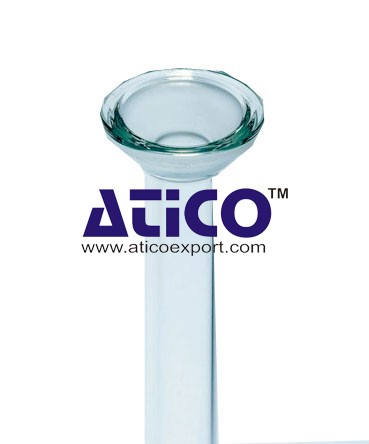
18. Thistle Funnels — For adding liquid to apparatus during reactions.
Storage & Handling Glassware
19. Reagent Bottles — For storing chemicals and solutions safely.
20. Specimen Jars — For biological specimen storage.
21. Desiccators — For keeping moisture-sensitive materials dry.
22. Watch Glasses — For evaporation, covering beakers, and holding small samples.
Support & Connection Items
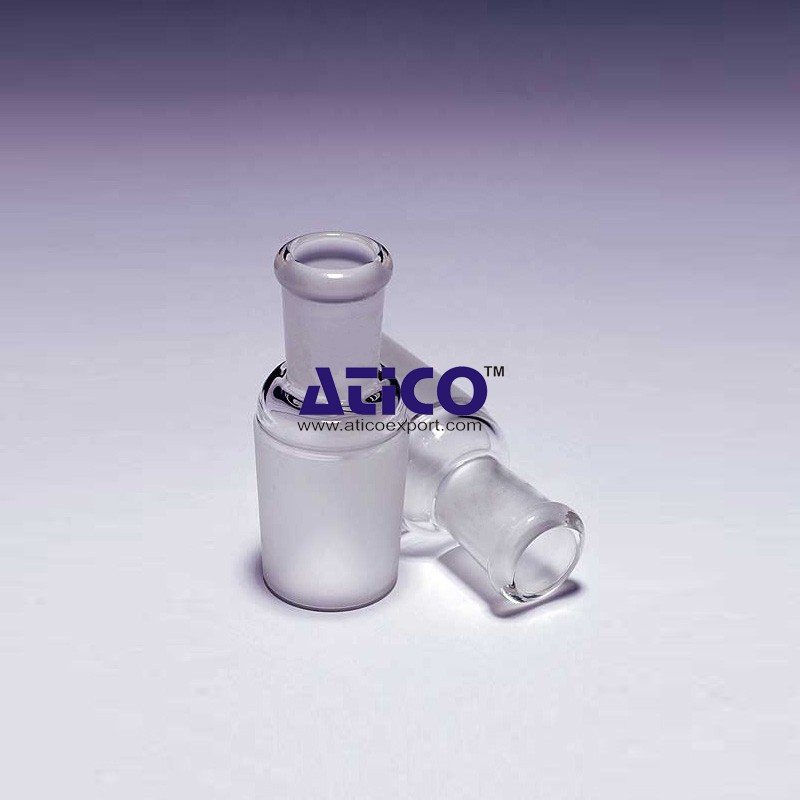
23. Standard Taper Joints & Adapters — For assembling glassware trains with airtight connections. The item most often under-ordered.
24. Glass Stoppers — For sealing flasks and bottles.
25. Glass Stirring Rods — For manual mixing without contamination.
Request a Custom Laboratory Glassware Quotation →
What to Check Before Ordering This List
Ordering 25 item types is where specification discipline matters most. Confirm all glassware is borosilicate 3.3 conforming to ISO 3585 — not a mix of borosilicate and cheaper soda-lime. Verify accuracy class on all volumetric items (Class A for research, Class B for teaching). Ensure standard taper joints are consistent across the order so items actually mate. And request a written bulk lead time, since a 25-item institutional order is rarely held in full stock everywhere.
For a full breakdown of material specifications, accuracy classes, and supplier evaluation criteria, read our complete laboratory glassware buying guide.
Common Mistakes When Buying Glassware in Bulk
Under-ordering connectors and adapters — the single most common gap, because they're less visible than beakers and flasks. Mixing accuracy classes unintentionally — ending up with Class B volumetric flasks in a research lab that needed Class A. Assuming all suppliers' joints are interchangeable — they aren't, unless the manufacturer controls dimensional consistency. Ordering piecemeal — losing bulk pricing and multiplying freight cost.
Why Choose Atico India
Atico India manufactures all 25 items on this list — and the wider laboratory glassware range — in borosilicate 3.3 conforming to ISO 3585, since 1957. A single bulk order covers the complete inventory, with consistent joint dimensions across every item, quality testing before dispatch, and export documentation handled in-house for international institutional buyers across 30+ countries.
FAQs
What are the most essential laboratory glassware items?
Beakers, conical flasks, volumetric flasks, graduated cylinders, burettes, pipettes, and test tubes form the core of most laboratories, supported by condensers, funnels, reagent bottles, and standard joints.
What material should laboratory glassware be made of?
Borosilicate 3.3 glass conforming to ISO 3585 — it withstands thermal shock and chemical exposure that ordinary soda-lime glass cannot.
Can I order all these items from a single manufacturer?
Yes. Atico India manufactures the complete range, allowing a single consolidated bulk order rather than sourcing items separately.
What's the difference between Class A and Class B volumetric glassware?
Class A offers higher accuracy for research and precise measurement; Class B is sufficient for general teaching use at lower cost.

.jpg)

.jpg)

0 Replies to “Methods of the recruitment”