
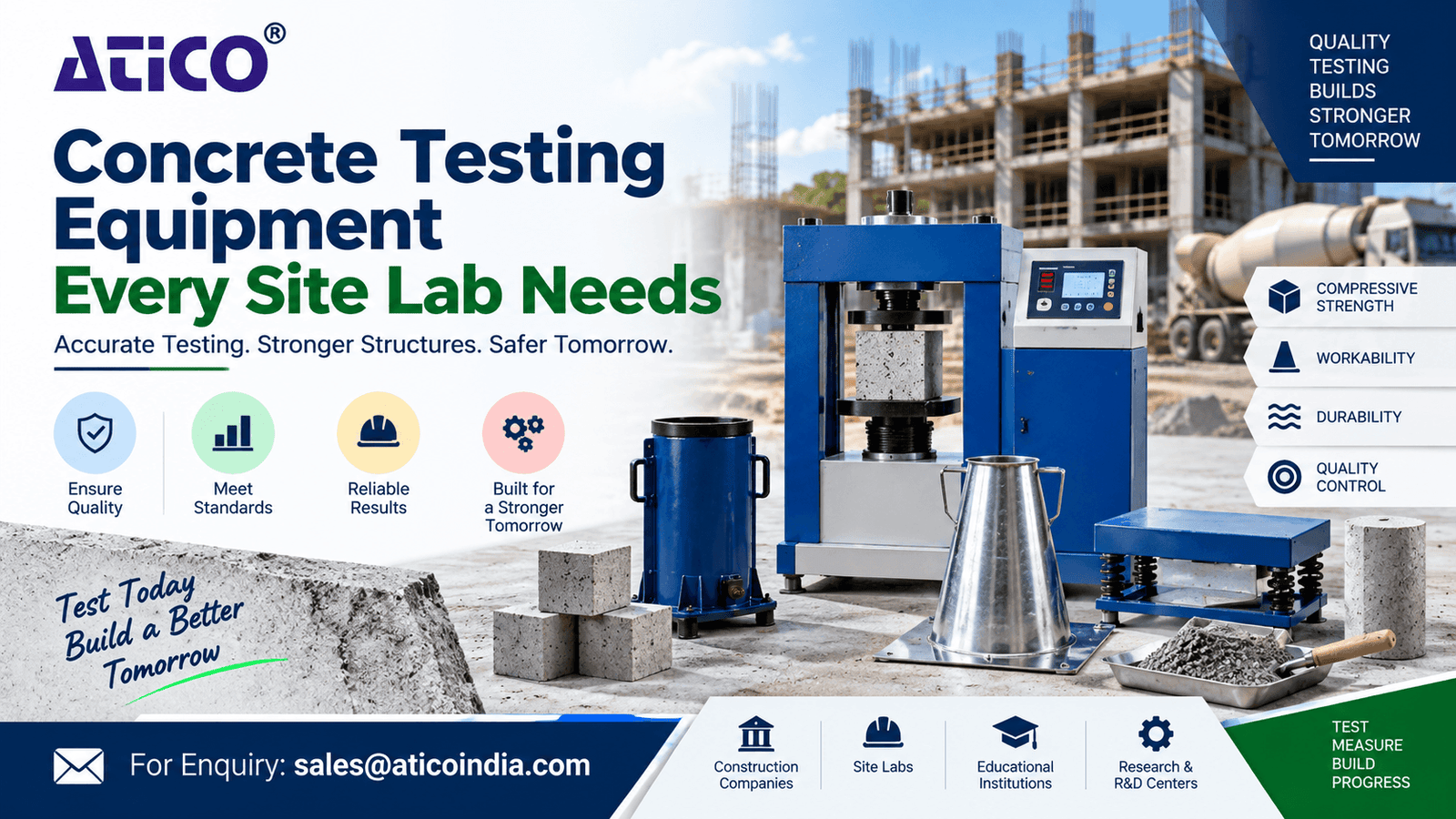
Concrete can be simple when it is being poured but it continues to change before, during and after it is poured. How it performs in a structure depends on its workability, density, air content, strength, curing conditions and durability. It is for this reason that a site laboratory must have more than just a compression testing machine.
The right concrete testing equipment can form a concrete testing chain: sample the fresh concrete, observe its performance, accurately prepare the samples, accurately cure the samples, and test the hardened concrete. Systematic testing of raw materials, fresh concrete and hardened concrete is an important aspect of concrete quality control as per Indian standard IS 516. Some of its more recent revisions also include information on compressive, flexural and split tensile strength, on non-destructive testing, and on other properties of hardened concrete.
What Concrete Testing Equipment is Necessary on a Site?
Tests performed should form the basis in designing a useful site-lab. Generally, the equipment can be divided into four phases: fresh concrete testing, specimen preparation, strength testing, in-situ assessment.
Slump Test Apparatus for Fresh Concrete
One of the first tests that is done when concrete is delivered to a job site is the slump test.
The consistency or workability of fresh concrete is determined using a slump cone, base plate and tamping rod. In the absence of changes in other mix variables, the result can show changes in water content or in aggregate grading and/or air content. Slump is also the standard method of measuring workability according to the American Concrete Institute (ASTM C143).
If the laboratory site is busy, the apparatus should be of quality, easy to clean and should be easily reproducible for repeated tests.
Cube moulds for preparing test specimens.
The reliability of a compression test is dependent upon the quality of the specimen being tested.
Cube moulds are used for the shape and dimensions of concrete to be tested for strength. The checklist for testing laboratory of ready mix concrete prepared by BIS also mentions cube moulds apart from specimen preparation as per IS 1199. Regular calibration and records for relevant testing equipment are also set out in the same checklist.
The good moulds are rigid and should be dimensionally uniform, and should be easily removed from the specimen without destruction.
Concrete Mixer and Vibrating Table
Good uniformity of specimen preparation is significant because the results of these tests may be influenced by poor uniformity and/or poorly compacted concrete.
A laboratory concrete mixer is used to mix consistent batches for controlled testing. A vibrating table may then help to compact the specimens, which will help to minimize unwanted voids.
These aren't the first things people would think of when designing a site lab, but they come into play when multiple test specimens are being produced at the lab regularly.
Compression Testing Machine
This is typically at the heart of a concrete testing laboratory.
The compression testing machine is used to apply a controlled load to a concrete sample until it fails, thus giving the concrete the strength that it has. The current testing framework of BIS specifies IS 516 Part 1/Sec 1:2021 for compressive, flexural and split tensile strength and states that the standard is to be reviewed in 2026. The ready-mix concrete checklist, issued by the BIS, requires a compression testing machine with a minimum capacity of 2000kN for the appropriate testing facility.
However, the machine must not only be powerful enough but will require additional consideration. Consider capacity, loading control, platen arrangement, accuracy, calibration, and type of specimen(s) being tested.
A Practical Concrete Testing Equipment List
Here is a typical site / construction laboratory with the following core equipment:
- Slump Test Apparatus
- Concrete Cube Moulds
- Compression Testing Machine
- Flexural Testing Machine
- Concrete Mixer
- Vibrating Table
- Curing Tank
- Air Entrainment Meter
- Compaction Factor Apparatus
- Flow Table
- Vee Bee Consistometer
- Concrete Permeability Apparatus
- Rebound Hammer
- Ultrasonic Pulse Velocity Tester
Currently, Atico India's concrete testing range comprises of compression testing machines, cube moulds, slump test apparatus, flexural testing machines, laboratory concrete mixers, vibrating tables, air entrainment meter, compaction factor apparatus, flow table and Vee Bee consistometers.
Choosing a Concrete Testing Equipment Manufacturer Is a Crucial Decision
The manufacturer is important because concrete testing is all about repeatability of measurements.
For us as a concrete testing equipment manufacturer, we are more interested in equipment that is suitable for practical use in the lab or field-testing applications. We have fresh concrete, specimen preparation, hardened concrete and a number of selected non-destructive testing applications. Also, various testing setups and support are available for laboratories that need customized setups.
We feel that buying equipment just because it's on a catalogue is not a good idea for a site lab. Begin with the definite grades, frequency of testing, applicable IS standards, and required tests of the project. Next, choose the equipment to have adequate capacity, accuracy, durability and calibration capabilities.
That approach is much more than a laboratory to simply generating a report, and provides the engineer with useful information while the quality of the concrete can be monitored and controlled.




0 Replies to “Methods of the recruitment”