
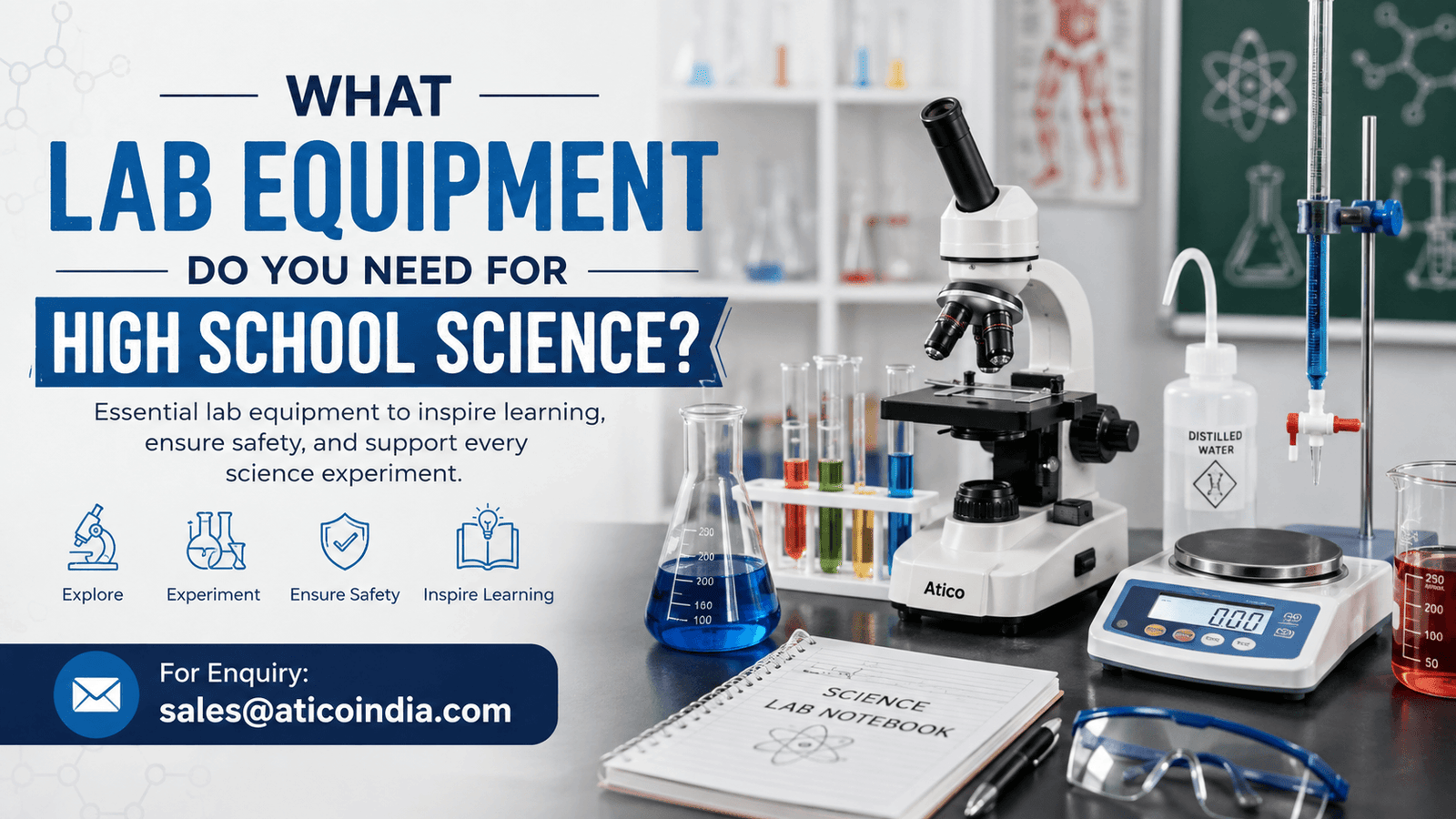
Science labs in high schools require equipment from three disciplines and some safety equipment. These include, in physics: instruments for measurement, mechanics, electrical, optics, and heat equipment. In chemistry: borosilicate glassware, Bunsen burners, chemicals and indicators. In biology: compound microscope, slides, dissecting equipment and models. Equipment used in all disciplines: safety goggles, fire and first aid supplies, fume removal system, and storage. The aim is not to have fancy equipment but just to have enough of these basics for each student to use.
The rest of this guide explains what matters within each category — and, just as importantly, what a high school does not need to spend on. Every year, schools spend significant portions of their science budget on laboratory equipment, and a surprising amount goes on the wrong things: expensive instruments that sit unused, or missing basics students actually need for required practicals.
The Complete High School Lab Equipment List
Here's the core inventory, stripped to what's genuinely essential across each subject:
Physics: measuring devices (rulers, vernier callipers, spring balances, stop watches), a set of mechanics equipment (pulleys, inclined planes, trolleys), sets of electrical equipment (cells, lamps, ammeters, voltmeters, resistance wire, connecting leads), optics equipment (lenses, mirrors, prisms, ray boxes), and simple heat equipment (thermometer, calorimeter).
Chemistry: Borosilicate glassware (beakers, conical flasks, test tubes, measuring cylinders, burettes, pipettes, funnels), apparatus for heating (Bunsen burners, tripods, gauze, spirit lamps), a set of chemicals and indicators, storage of chemicals.
Biology: Compound microscope, mounted slides, dissecting equipment, human anatomy model and plants model, specimen jars and biological charts.
Safety and laboratory equipment: Safety goggles, gloves, first aid, fire safety equipment, laboratory furniture and storage, and arrangement for fume extraction for chemistry.
That's the backbone. Everything below explains what matters within each category — and what a high school does not need to spend on.
Physics Equipment for High School
High school physics is built on demonstrable, hands-on principles — motion, force, electricity, light, and heat — so the equipment should let students do, not just watch.
The essentials start with measurement: metre rules, vernier calipers, micrometer screw gauges, spring balances, and stopwatches. These support the mechanics practicals that appear in almost every high school syllabus. A mechanics set — pulleys, inclined planes, trolleys, and weights — covers force, motion, and energy experiments.
The area where labs fall short in equipment provision is electricity. The number of cells, bulbs, ammeters, voltmeters, resistance wires, rheostats, and connecting wires should be adequate for a class to conduct experiments in small groups rather than sharing a few in the lab. Optics demands convex and concave lenses, plane and curved mirrors, prisms, and ray boxes to experiment on reflection and refraction. Heat is adequately provided with thermometers, calorimeters, and heating agents.
Items which high schools do not require in their laboratories are electronic trainer, oscilloscopes, and any other laboratory apparatus intended for research. This kind of equipment is supposed to be in polytechnics and universities and not high school laboratories because when such equipment is acquired, the funds could have been put to better use elsewhere.
Chemistry Equipment for High School
Chemistry has the highest safety stakes of the three subjects, so equipment quality matters most here.
Glassware forms the basis, and the most critical specification would be the grade of the glass. High school glassware should be made out of borosilicate glass, which does not crack under the heat, while soda-lime glass will definitely break when heated. It is one thing for a beaker to crack on a flame in a room full of students; it is quite another kind of event altogether. Basic Glassware Set
- Beakers
- Conical/Erlenmeyer Flasks
- Test Tubes
- Measuring Cylinders
- Burettes
- Pipettes
- Funnels
Heating equipment covers Bunsen burners, tripod stands, wire gauze, and spirit lamps. Beyond that, a high school needs a working set of common reagents and indicators for the required practicals, along with proper reagent storage — labelled, secure, and separated by chemical compatibility.
Safety is not optional in a chemistry lab: goggles for every student, gloves, a fume-extraction arrangement, clearly accessible fire safety equipment, and first-aid provision. Schools sometimes economize on safety to stretch the budget on apparatus. That's the one place economizing is genuinely dangerous.
Biology Equipment for High School
Biology is a subject of observation, so the microscope is the centerpiece of the lab.
For high school, compound microscopes with a magnification range suited to the syllabus are the essential purchase — enough units that students work in small groups rather than one class sharing a single instrument. Supporting these are prepared microscope slides (for cells, tissues, and microorganisms students can't easily prepare themselves) and blank slides for their own specimen work.
Beyond microscopy, a biology lab needs dissection kits and trays for practical anatomy work, human anatomy models and plant models for structural teaching, specimen jars for preserved samples, and biological charts as teaching aids. These models and charts do a lot of teaching work at relatively low cost, which makes them efficient budget choices.
What's usually unnecessary at high school level: research-grade or specialized microscopes, advanced staining and culture equipment, and anything oriented toward independent research rather than syllabus practicals.
What Schools Commonly Get Wrong
Three patterns repeat across school laboratory procurement.
Over-buying on sophistication, under-buying on quantity. A lab buys one impressive advanced instrument instead of ten sets of the basic equipment students actually need. The result is an expensive item gathering dust while the class shares too few working sets to run a proper practical.
Ignoring the glass grade. Buying cheaper soda-lime glassware to save money, then replacing it repeatedly as it cracks under heat — while also accepting a genuine safety risk. Borosilicate costs more upfront and less over the lab's life.
Treating safety equipment as the flexible line item. When budgets tighten, safety goggles, fume extraction, and fire provision are the first things cut. This is exactly backwards: in a room of students handling chemicals and flames, safety is the least negotiable spend.
How to Prioritize on a Limited Budget
Most schools don't have unlimited budgets, so sequencing matters. A practical order of priority:
First, safety equipment — goggles, fire and first-aid provision, fume extraction. This is non-negotiable and comes before any apparatus. Second, the core consumable and glassware sets that every practical depends on, in enough quantity for group work. Third, the subject-specific essentials: microscopes for biology, electricity and mechanics kits for physics, heating and reagent sets for chemistry. Fourth, models, charts, and teaching aids that extend learning at lower cost. Last, and only once the essentials are covered in adequate quantity, any advanced or specialized equipment.
The guiding principle: enough of the basics for every student to work hands-on beats one impressive instrument the class watches from a distance. Depth of quantity teaches more than depth of sophistication at the high school level.
Buying High School Science Equipment: A Note on Suppliers
Where one requires complete laboratory equipment for high school science, getting the equipment from one supplier in the fields of physics, chemistry, and biology would be much simpler compared to sourcing from different suppliers. Moreover, matching all the equipment to a particular curriculum would also be much easier.
Atico India manufactures the complete range of high school science laboratory equipment — physics lab equipment, chemistry lab equipment, and biology lab equipment, along with laboratory glassware, microscopes, and safety equipment — supplying schools in India and across international markets.
Request a School Science Lab Equipment Catalogue →
FAQs
What is the most essential equipment for a high school science lab?
Across the three subjects: measuring and electricity equipment for physics, borosilicate glassware and Bunsen burners for chemistry, and microscopes for biology — plus safety equipment shared across all. Adequate quantity of these basics matters more than advanced instruments.
Is High School Chemistry Laboratory Glassware Made of Borosilicate Glass
True, as the borosilicate glass is heat-shock-resistant glass. It is more reliable and safe to use than common soda lime glass in a high school environment..
How many microscopes do high school biology labs require?
Enough to enable students to use it in groups rather than sharing one single microscope as a class. The number required varies based on class size. The idea is group level access to equipment.
Which laboratory equipment is unnecessary for high schools?
Laboratories that require research grade equipment, electronic trainers, oscilloscopes, and microscopes are not necessary in high schools.
How should a school prioritize a limited science budget?
Safety equipment first, then core glassware and consumables in adequate quantity, then subject-specific essentials (microscopes, electricity kits, heating apparatus), then models and teaching aids, and advanced equipment last.
Conclusion
Proper outfitting of a high school science laboratory is not about getting the most fancy equipment from catalogs but rather about purchasing the necessary things in the proper amounts and of the necessary quality. Make sure that all the basic things are available in terms of physics, chemistry, and biology; do not skimp on safety and favor quantity over quality. That's how you teach science.








0 Replies to “Methods of the recruitment”