
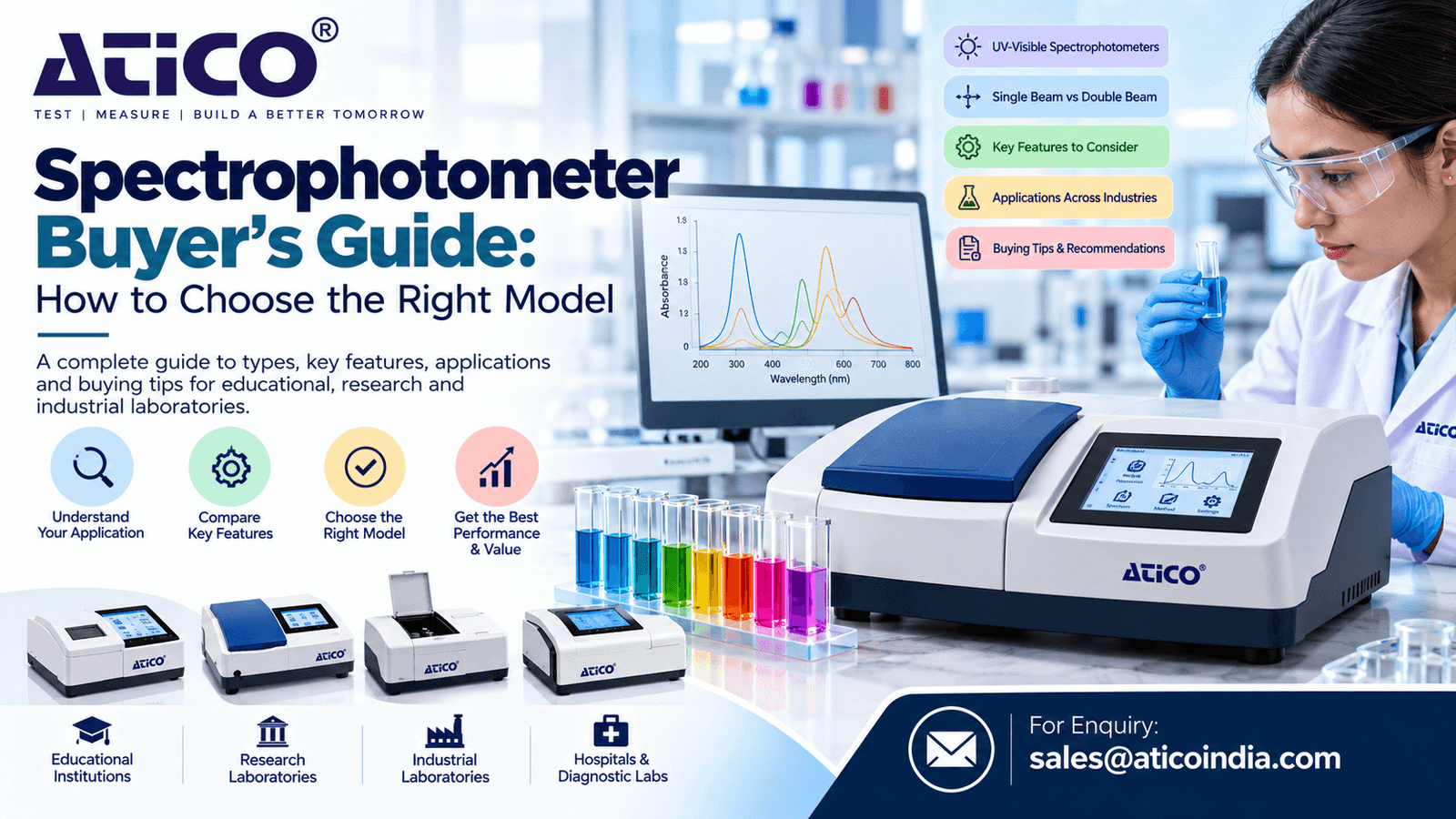
When selecting a spectrophotometer, there are more factors to consider than just the price and spectral range offered. The choice of instrument will depend on the sample, analytical technique, sensitivity needed, measurement range, and workload at the laboratory. As spectrophotometer manufacturers, we recommend the assessment of the whole configuration of the instrument before purchasing. This is particularly important if the equipment will be used in a laboratory over the years for routine measurements.
Atico India has several spectrophotometric configurations, such as
- Microprocessor Double Beam UV-VIS Spectrophotometer
- Microprocessor Single Beam UV-VIS Spectrophotometer
- Digital Spectrophotometer
- Microprocessor Visible Spectrophotometer
- Double-beam spectrophotometer
- Bio Spectrophotometer
- Atomic Absorption Spectrophotometers.
The AAS models should be evaluated individually, as atomic absorption is not the measurement of molecular absorbance, as with the UV-Vis absorbance models.
Start With These Seven Checks Before Choosing a Model
The buyer has to specify the application first and then refer to the technical specifications. Broadening the specification does not necessarily mean that it is a better fit; it must match the laboratory's actual testing needs.
The application:
Determine if the instrument is going to be used in pharmaceutical, chemical, food, environmental, biochemical, educational, and/or research applications. The double-beam UV-Vis model that Atico offers, for instance, mentions biochemical research, pharmaceutical analysis, education, environmental protection, food, clinical and sanitation applications.
Wavelength range:
Determine if the desired analytical techniques are in the instrument's wavelength range. Atico's Digital Spectrophotometer range is 340-960 nm, and Atico Microprocessor Double Beam UV-VIS 190-1100 nm. For a UV application, a model is therefore needed that is able to function in the desired UV region.
Single or double beam:
Single-beam systems may be acceptable for simple routine measurements, and double-beam systems may be necessary for more advanced scanning work and for greater stability of measurements. It can be determined by the application and testing frequency.
For photometric:
Never use wavelength band as the only criterion. Check photometric accuracy, repeatability, stray light, baseline stability, noise, and wavelength accuracy. A double-beam UV-Vis model is also available from Atico; its specifications include ±0.3 nm wavelength accuracy, <0.15% T photometric reproducibility, and <0.1% T stray light, demonstrating the level of specifications that should be taken into account.
Sample handling:
Ensure you have the available cuvette path length, sample holder, and compatible material of the cell. Atico's Digital Spectrophotometer is available in 10 mm and 50 mm path length models and a double-beam UV-Vis model is supplied with glass and quartz cells.
Software and data handling:
In research and routine analytical laboratories, it supports wavelength scanning, time scanning, multi-wavelength analysis, data storage, data printing, and computer connection. Atico's double-beam is capable of multiple modes such as wavelength scan, time scan, multi-wavelength, and derivative measurement, and it is equipped with RS-232 and printer output.
Model selection:
Choose the simplest model that satisfies the laboratory's needs. A microprocessor or visible digital spectrophotometer may be required for visible testing, or a single- or double-beam UV-Vis system may be warranted for wider UV-Vis use. Applications involving bioassays can be accommodated with the Bio Spectrophotometer, and the elemental analysis can be performed using the proper AAS configuration.
Before You Choose a Spectrophotometer Manufacturer, Supplier, or Exporter, What Should You Check?
Manufacturer:
Do not choose spectrophotometer manufacturers that present just a catalogue of instruments but also a company with real technical and production capacity. See if specifications are well documented, completed instruments are tested, customization is available, and the manufacturer can offer application-expert guidance. According to Atico India, its scientific instruments are subjected to final testing, and it offers customized solutions to the requirements of its customers.
Supplier:
A good spectrophotometer supplier should be consistent in the model that they quote and the instrument supplied. Check the exact model, wavelength range, accessories, sample cells, software, warranty, technical assistance, and availability before ordering. It is also important to have a supplier that is able to place a single order for a variety of instruments for laboratory projects or other bulk orders.
Exporter:
When buying overseas, look at the export process as well as the product. The exporter should have the ability to handle and oversee specification verification, protective export packaging, commercial documentation, packing details, and shipping coordination. Atico India says it supplies laboratory equipment internationally in over 30 countries and provides bulk and tender.
Why Choose Atico India?
As one of the leading spectrophotometer manufacturers, we do not consider all labs to be equal; each has different requirements, and we manufacture and supply a number of spectrophotometer configurations at Atico India.
A complete chain, starting from instrument design and manufacture, inspection, configuration, documentation, supply, and long-term technical support, is the basis for a reliable spectrophotometer purchase. Selection based on this provides laboratories a more solid basis for getting consistent measurements and maintaining the usefulness of the instrument as the testing needs change.


0 Replies to “Methods of the recruitment”