
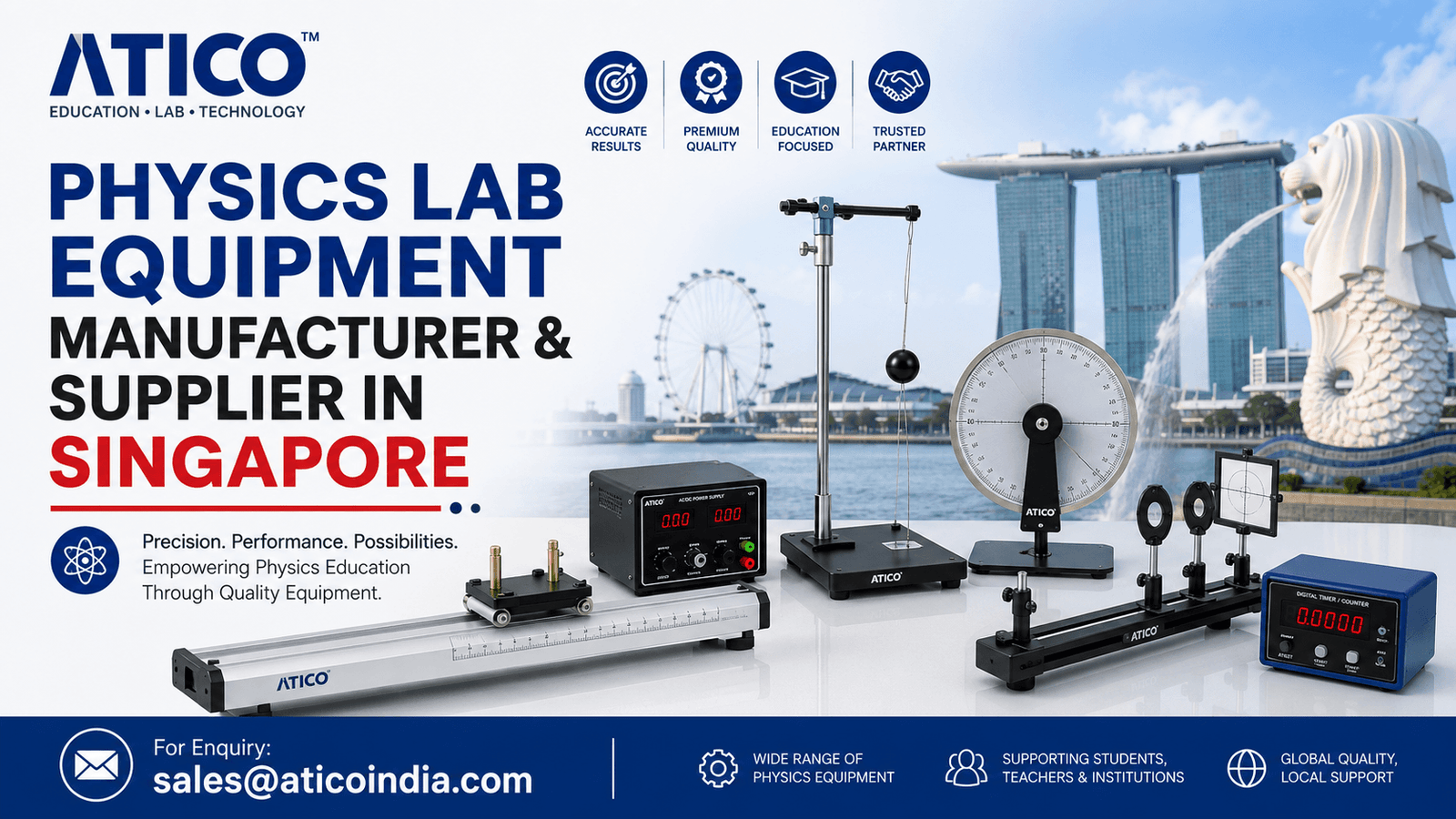
Setting up a physics lab in Singapore isn't just about ticking boxes on a procurement form. Whether it's a secondary school preparing students for O-Level and A-Level practicals, a polytechnic running engineering foundation courses, or a private institute building out a new STEM wing, the equipment has to actually hold up - accurate, safe, and durable enough to survive years of student handling.
Atico India has been manufacturing physics laboratory equipment for decades, and a meaningful share of that goes to institutions outside India, including schools, colleges, and training centres across Southeast Asia. This guide covers what a complete physics lab setup actually needs, what to look for in a manufacturer or supplier, and a few questions that come up often from Singapore-based buyers.
Physics Lab Equipment Manufacturer in Singapore
A lot of buyers default to whichever supplier shows up first in a Google search or trade directory. That works fine until something breaks, or a custom configuration is needed for a specific experiment, or a part needs replacing two years down the line. A manufacturer controls the actual production — materials, calibration, tolerances — and can answer technical questions a reseller usually can't. If you're equipping a lab that needs to last a decade, that distinction is worth a few extra minutes of due diligence before signing off.
Physics Lab Equipment List by Atico India
A reasonably complete physics lab — whether for a secondary school or a polytechnic foundation course — typically includes equipment across these areas:
Mechanical Lab Equipment: spring balances, pendulum sets, inclined planes, Hooke's law apparatus, and friction demonstration kits.
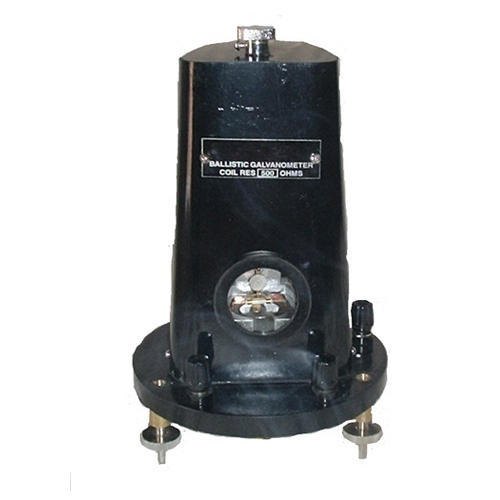
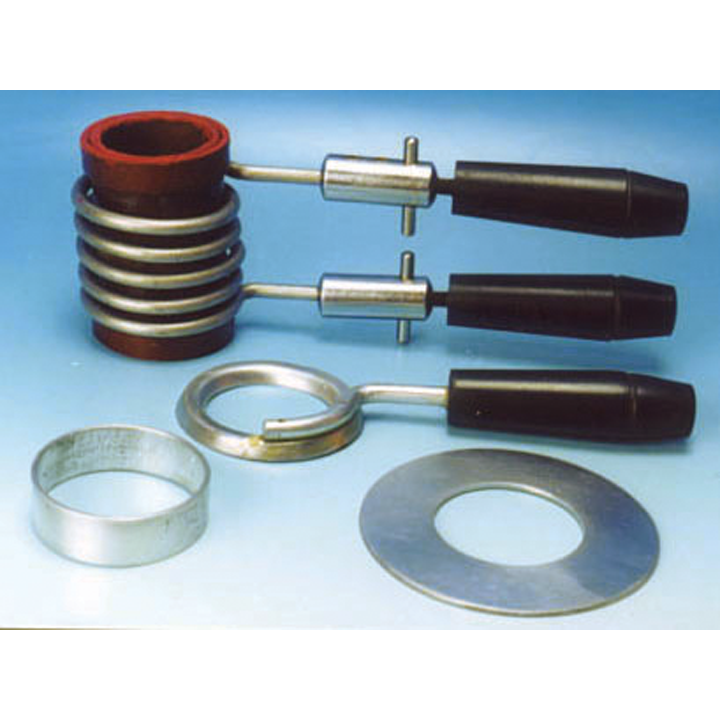
Electricity and magnetism: ammeters, voltmeters, galvanometers, resistance boxes, rheostats, and electromagnetic induction kits.
Optics: optical benches, ray boxes, convex and concave lens sets, prisms, and mirror sets for reflection and refraction experiments.
Heat and thermodynamics: calorimeters, thermometers, specific heat apparatus, and heat conduction/convection demonstration kits.
Measurement instruments: vernier calipers, micrometer screw gauges, digital multimeters, and stopwatches.
Modern physics (for higher-level courses): photoelectric effect apparatus, radioactivity demonstration kits, and basic spectrometers.
A polytechnic or junior college lab will usually need a more advanced version of most of these — higher precision, digital readouts, and sometimes data-logging capability — compared to a secondary school setup.
What to Check Before Choosing a Supplier
A few things matter more than price when comparing options. Does the manufacturer state material specifications clearly, rather than vague terms like "high quality"? Can they confirm compliance with relevant international standards? Do they have actual export experience to Singapore or Southeast Asia, including documentation and freight handling? What's the warranty period, and how quickly can spare parts be sourced if something fails? And critically — will they customize a configuration if your syllabus needs something slightly different from the standard catalog?
A supplier who answers all of this clearly is worth the relationship. One who hedges on any of it is a risk you're taking on without realizing it.
Why Atico India
Atico India produces all laboratory equipment listed above. Their equipment is made to standard specifications and comes with export documentation and packaging for international shipping. The catalog includes equipment for secondary school as well as polytechnic and university labs, which is important for institutions that have to equip multiple labs and want to use a single supplier.
Request a quote for your physics lab setup.
FAQ
Does Atico India ship physics lab equipment to Singapore?
Yes. Atico India exports laboratory equipment internationally, with export documentation and packaging suited for overseas freight.
What's the difference between a manufacturer and a supplier?
A manufacturer manages production directly. Being direct means better customization. Specifications are made clearer when there’s a direct line to the manufacturer as a real contact for warranty or spare parts. With a supplier or distributor, what the manufacturer makes is usually what the supplier or distributor sells to/from the manufacturer. There is less control on either side.
Can equipment be customized for a specific syllabus or experiment?
Generally yes, for a genuine manufacturer. This is one of the clearest signals of working with an actual manufacturer rather than a reseller — ask directly before placing an order.
How long does international shipping typically take?
This varies by order size and destination port, but institutions should request a written delivery timeline before confirming an order, not after.
Is there a difference between secondary school and polytechnic-level physics equipment?
Yes, polytechnic and university-level apparatus generally need higher precision, digital readouts, and sometimes data-logging features that secondary school equipment doesn't require.
Atico India is the most trusted physics lab equipment manufacturer and supplier, serving schools, polytechnics, and institutions across Singapore and worldwide. Write to sales@aticoindia.com for a customized equipment list and quote.

0 Replies to “Methods of the recruitment”