
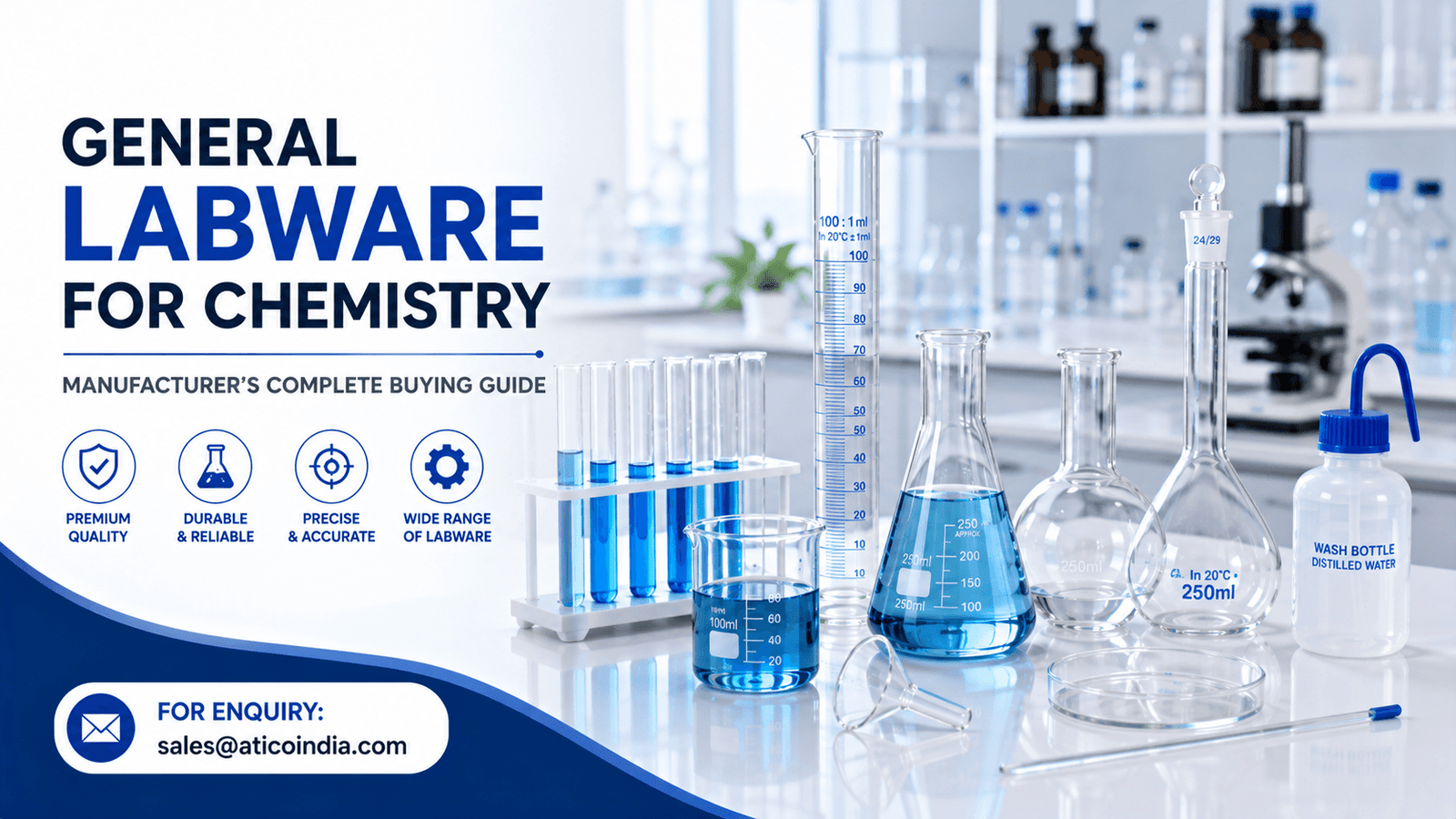
Most chemistry lab setup lists are written by people who have never had to sign off on the purchase order. They list everything, in every material, at every capacity, and leave the buyer to figure out what actually matters. This guide does the opposite. It covers the general labware a working chemistry lab genuinely needs, where the material choice changes the outcome, and where it does not.
What Counts as General Labware in a Chemistry Lab
General labware is the everyday equipment a chemistry lab uses across almost every experiment, regardless of the specific work being done. It is separate from instruments like spectrophotometers or balances, and separate from specialised apparatus tied to a single technique.
If a chemistry department runs titrations on Monday, filtration on Tuesday, and distillation on Wednesday, the general labware is the set of items that appears on all three days. Beakers, flasks, funnels, measuring cylinders, stands, and storage bottles. This is the equipment that gets used, washed, and used again, which is why buying decisions here have more long-term impact than buyers expect.
General Labware for Chemistry: The Complete List
Below is the general labware that appears in nearly every chemistry lab, grouped by what the item actually does rather than by material.
Measuring and Transferring Labware
Beakers are the workhorse. They are used for mixing, holding, and rough volume estimation. Note that beaker graduations are approximate, so they are not measuring instruments in any precise sense.
Measuring cylinders give reasonably accurate volume readings and are used whenever a beaker is not precise enough.
Volumetric flasks are for preparing solutions at an exact concentration. Each one is calibrated to a single volume marked on the neck.
Pipettes and burettes handle controlled delivery of liquid. Burettes are essential for titration work, which is a core practical in almost every chemistry syllabus.
Funnels move liquids and powders into narrow-necked containers without loss.
Heating and Reaction Labware
Conical flasks, also called Erlenmeyer flasks, are used for reactions and titrations. The narrow neck reduces splashing and allows swirling without spillage.
Round-bottom flasks are used where uniform heating is needed, particularly in distillation and reflux setups.
Test tubes handle small-scale reactions and observations. Most labs buy these in large quantities because they see heavy use and regular breakage.
Watch glasses cover beakers during heating and hold small solid samples.
Separation and Filtration Labware
Separating funnels split immiscible liquids, a routine requirement in organic chemistry practicals.
Filter funnels combined with filter paper handle basic gravity filtration.
Condensers are used in distillation to convert vapour back to liquid. This is where material choice stops being negotiable, and we cover why in the next section.
Desiccators keep samples dry during storage and cooling.
Support, Storage and Handling Labware
Retort stands, clamps, and bosses hold everything else in place. Labs consistently under-order these and then discover that half their glassware has nothing to sit in.
Test tube racks and stands, wash bottles, reagent bottles, and spatulas complete the working set.
Tongs and holders handle hot glassware. These are cheap and routinely forgotten in setup lists until someone burns a hand.
Glass or Plastic: The Decision Most Labs Get Wrong
Here is the position we take, and it costs us money to say it.
Most buying guides push borosilicate glass across the entire order because glassware carries a higher margin. That advice is wrong, and any procurement officer who follows it wastes budget.
The honest rule is narrower. Use borosilicate glass where the item faces heat, direct flame, thermal shock, or aggressive reagents. That means beakers used on hot plates, flasks used for distillation or reflux, condensers, and anything going into a drying oven. Soda-lime glass will fail in these roles, and it will fail in the middle of a student practical.
Use plastic where those stresses are absent. Wash bottles, storage bottles, test tube racks, funnels used at room temperature, and general handling items perform identically in polypropylene or polyethylene, cost less, and do not shatter when a first-year student drops them. In a teaching lab with high student throughput, plastic often makes more sense than glass for exactly this reason.
The buyers who get this right specify by function, not by material preference. The ones who get it wrong either over-specify glass and blow the budget, or under-specify it and replace cracked beakers every term.
How Much General Labware Does a Chemistry Lab Actually Need
Quantity is where most first-time orders go wrong, in both directions.
The practical method is to work from student count, not from a generic list. If a practical runs with twenty students working in pairs, you need ten complete sets of the apparatus for that practical, plus a margin for breakage. For high-turnover items like test tubes and beakers, a twenty to thirty percent buffer over calculated need is realistic for a teaching lab. For items that rarely break, such as retort stands, no buffer is needed.
The second common error is ordering one capacity of everything. A lab that only owns 250 ml beakers will improvise badly when an experiment calls for 50 ml. Ordering across a spread of capacities costs marginally more and prevents that problem entirely.
What to Look for in a General Labware Manufacturer
The distinction that matters most is whether you are buying from a general labware manufacturer or from a trader who has repackaged someone else's stock.
A manufacturer can tell you what material a specific item is made from, can hold that specification consistent across a repeat order two years later, and is accountable when something arrives wrong. A trader can do none of these reliably, because the underlying source can change between orders without the trader knowing or telling you.
This matters more than buyers expect. Institutions rarely buy labware once. They restock. When the second order arrives with different wall thickness or a different glass grade than the first, the lab discovers the problem during a practical, not during inspection.
Atico India is a general labware manufacturer. We have produced laboratory glassware, laboratory plasticware, and general labware in-house at our facility at Atico House, 5309 Grain Market, Ambala, India, since 1957. We operate under ISO 9001:2015, CE, and WHO-GMP certifications, which cover our manufacturing and quality-management processes.
Choosing a General Labware Supplier for Bulk Orders
Bulk procurement has different failure points than one-off buying. A general labware supplier who is good at small orders may be poor at institutional supply, and the difference shows up in three places.
The first is quantity consistency. Supplying fifty beakers is easy. Supplying five hundred with the same specification, from the same production run, is a manufacturing question rather than a stocking question.
The second is documentation. Institutional and government buyers need specifications, invoices, and compliance paperwork that will survive an audit. Missing paperwork holds up payment even when the goods arrived correctly.
The third is replacement. Breakage happens in transit and in use. A supplier who cannot restock a specific item at the original specification forces the lab into a mismatched inventory.
Working With a General Labware Exporter
When the order crosses a border, add a fourth requirement. A general labware exporter has to handle export documentation, packaging that survives long-haul freight, and country-specific import requirements. Glassware in particular fails in transit when packed by someone who has not done it before.
Atico India works as a general labware exporter to more than 30 countries across Africa, the Middle East, and Southeast Asia. We handle export documentation, packaging, and international shipping for institutional and government orders. Send us your requirement list and destination country, and our export team will respond with a bulk quotation, specifications, and shipping timelines.
Frequently Asked Questions
What is general labware in a chemistry lab?
General labware is the everyday equipment used across most chemistry experiments, rather than apparatus tied to one technique. It includes beakers, flasks, measuring cylinders, funnels, test tubes, retort stands, and storage bottles. It is distinct from instruments such as balances or spectrophotometers.
Should chemistry labware be glass or plastic?
It depends on the item's role. Use borosilicate glass where the item faces heat, flame, thermal shock, or aggressive reagents, such as beakers on hot plates, distillation flasks, and condensers. Use plastic for items that do not face those stresses, such as wash bottles, racks, and room-temperature funnels. Plastic costs less and does not shatter, which matters in teaching labs.
How do I order general labware in bulk for a school or university?
Work out quantities from your student count and practical group size rather than from a generic list, add a breakage buffer of twenty to thirty percent on high-turnover items, and order across a spread of capacities. Then send the requirement list along with your destination country to a general labware manufacturer who can quote directly rather than through a trader.








0 Replies to “Methods of the recruitment”