
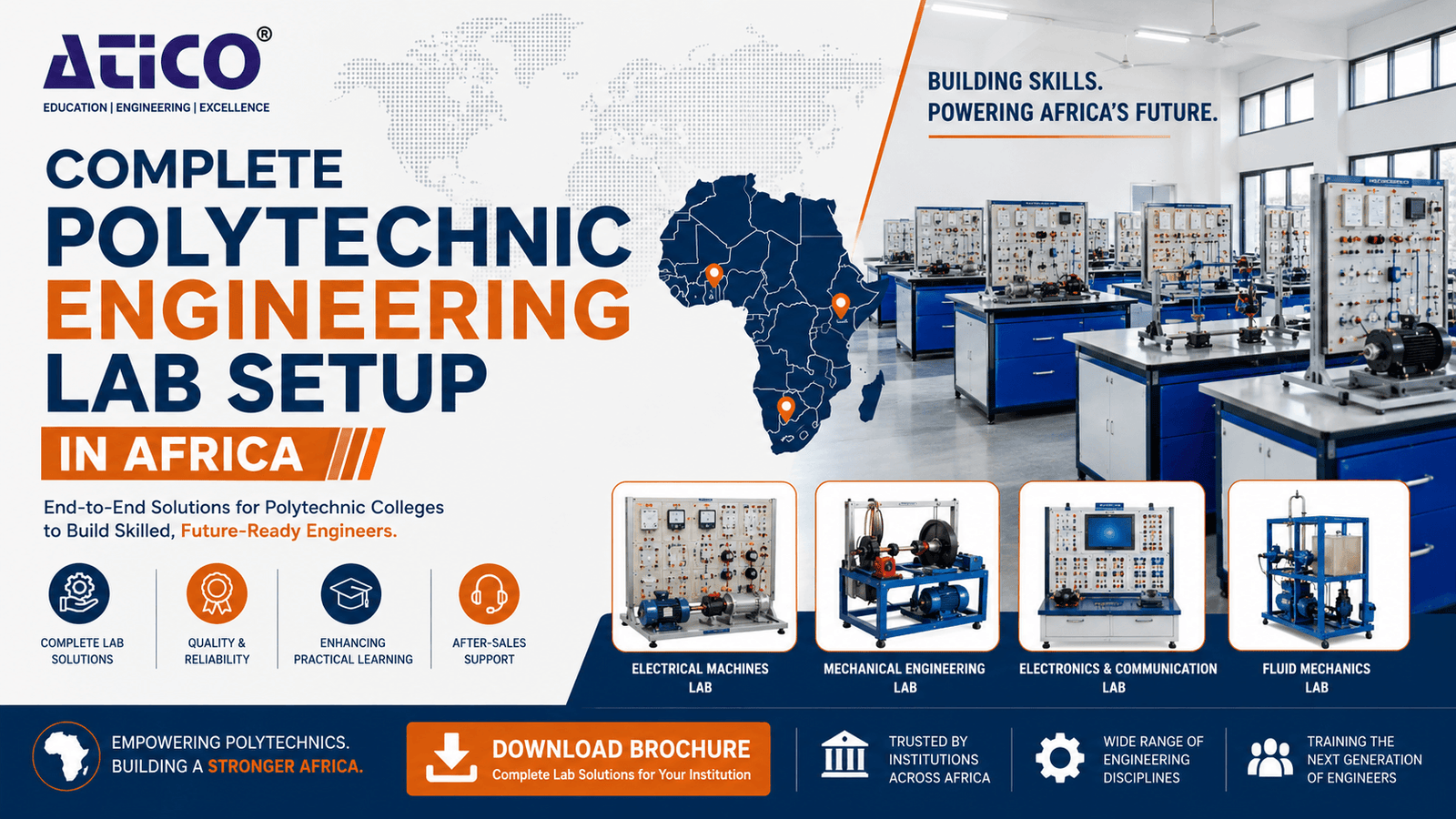
Setting up a polytechnic engineering lab in Africa requires more than compiling an equipment checklist; it demands precise alignment with regional educational frameworks like TVET to secure institutional accreditation. At Atico India, established in 1957, we believe that engineering laboratory setups must prioritize rugged durability and calibration consistency over cheaper, uncertified imports that fail ministry inspections. Whether you are establishing a new vocational workshop from the ground up or updating high-wear civil testing apparatus, we provide comprehensive, curriculum-aligned equipment packages. Explore our specialized educational trainers and engineering lab equipment designed to pass strict regulatory audits and deliver dependable hands-on student training.
Why "Complete Lab Setup" Is the Right Frame - Not "Equipment Purchase"
Most lab procurement failures across African institutions share a common cause: the project was scoped as an equipment purchase when it should have been scoped as a complete setup.
An equipment purchase ends when the crates arrive at the port. A complete setup ends when students are running experiments, faculty have been trained on the apparatus, replacement parts are stocked, calibration schedules are documented, and the lab has been formally commissioned to the institution's accreditation standards. The cost difference between these two scopes is approximately 15–20% of the total project. The outcome difference is the difference between a working lab and a storeroom of imported boxes.
A serious complete lab setup involves seven distinct deliverables (meaning: tangible outputs or services that a project must produce to be considered complete) that any credible supplier should commit to in writing:
Curriculum alignment. The equipment inventory must reflect the institution's syllabus along with the relevant national engineering accreditation criteria — whether Nigeria's NBTE framework, South Africa's QCTO/SETA standards, Kenya's TVETA syllabus, or Ghana's COTVET requirements. A generic equipment list dropped into a curriculum-specific institution creates gaps that students encounter during experiments and faculty must work around in lesson planning.
Specification documentation. Each item must have a written specification sheet stating materials, dimensions, capacity, accuracy class, applicable international standards (ISO, ASTM, IS), and safety certifications. This is the document procurement auditors will request and the document warranty claims will reference.
Pre-shipment inspection rights. The buyer must have the contractual right to inspect equipment at the manufacturer's facility before shipment, or to appoint a third-party inspection agency. This single clause eliminates most post-shipment disputes.
Export packaging and freight planning. Sensitive equipment — glassware, electronic trainers, optical instruments — must be packed for sea or air freight to African ports with proven case designs. Ports like Apapa (Lagos), Mombasa, Durban, and Tema each have their own customs clearance idiosyncrasies that the supplier should know.
Installation and commissioning. Either the manufacturer sends technicians to install and commission, or they provide installation manuals and remote support comprehensive enough that local technicians can complete the work. Vague "installation guidance" is not a commissioning plan.
Faculty training. Equipment that nobody on faculty knows how to operate becomes shelf inventory. Training — either in-person or via documented video curricula — must be part of the scope.
Spares and after-sales commitment. Written lead times for spare parts, guaranteed availability windows, and a named technical support contact. This is where most multi-year relationships either succeed or quietly collapse.
If a supplier hesitates on any of these seven, the institution is not buying a complete lab setup. It is buying equipment and hoping the rest will work itself out.
What a Complete Polytechnic Engineering Lab Actually Contains
The setup of an engineering lab will be determined by the fields available at the polytechnic. Most of the polytechnics in Africa offer courses in civil, electrical, mechanical, electronics, and chemical engineering. But some offer courses in other branches of engineering as well, like automotive engineering, refrigeration and air conditioning, and renewable energy.
Engineering Laboratory Equipment Includes:
Civil engineering laboratory. A complete civil engineering lab typically includes:
- Soil testing apparatus: covering compaction, CBR, shear, and consolidation tests
- Aggregate testing equipment
- Cement and concrete testing apparatus
- Bitumen testing kits
- Surveying instruments
- Material testing machines, including universal testing machines and Rockwell hardness testers
Civil engineering is among the most equipment-intensive disciplines and typically represents the largest single budget line in a polytechnic engineering lab project.
Electrical engineering laboratory.
- Electrical machines benches covering motors,
- generators, and transformers;
- power electronics trainer kits for converters,
- inverters, and rectifiers;
- circuit and network trainers;
- measurement instrumentation including digital multimeters,
- Oscilloscopes,
- function generators,
- digital storage oscilloscopes;
- control system trainers; and
- educational motors
- machine cut-models.
Mechanical engineering laboratory.
- Fluid mechanics and hydraulics benches,
- thermodynamics apparatus,
- heat transfer equipment,
- theory of machines apparatus,
- internal combustion engine cut-models,
- refrigeration and air conditioning trainers, and
- material testing equipment
Electronics and communication laboratory.
- Analog and digital electronics trainers,
- communication system trainers (analog, digital, satellite, microwave),
- fiber optic trainers,
- antenna and RF trainers,
- embedded systems and microprocessor trainers
- instrumentation trainer kits.
Chemical engineering laboratory.
- Mass transfer and momentum transfer equipment,
- unit operations apparatus,
- process control technology trainers,
- biochemical engineering setups.
- Laboratory glassware,
- fume hoods,
- standard chemistry apparatus.
Supporting infrastructure.
- Laboratory furniture,
- fume hoods,
- safety equipment,
- storage cabinets,
- glassware (borosilicate 3.3 to ISO 3585 specification),
- microscopes for relevant disciplines,
- interactive whiteboards or
- projection systems for instructional use.
A polytechnic lab project at moderate scale typically involves 200–800 distinct line items. The procurement officer who tries to source these from a dozen separate vendors discovers, usually too late, that vendor coordination consumes more staff time than the equipment itself cost.
Why Consolidating with One Manufacturer Matters More in African Procurement
Lab equipment procurement in African markets carries logistical realities that domestic procurement in Europe or North America does not. Ocean freight from manufacturing origins to African ports takes 4–8 weeks. Customs clearance can add 2–6 weeks depending on port and documentation completeness. The addition of each new supplier increases these times and also adds new failure points.
A successful partnership with a single manufacturer that manufactures in all the different disciplines such as civil, electrical, mechanical, electronics, chemical, and lab equipment ensures that the purchase of these products is under one order, one shipping timeline, one documentation process for customs clearance, and one warranty agreement. The Atico India company has taken up this model of consolidation whereby they manufacture all the polytechnic and engineering equipment from a single manufacturer within India, and then export to different countries in Africa, namely Nigeria, South Africa, Kenya, Ghana, and Ethiopia.
The financial impact of consolidation is non-trivial (meaning: significant; not insignificant or negligible). On a typical polytechnic engineering lab project, consolidating across one manufacturer rather than five to seven specialty vendors typically reduces total landed cost by 8–15%, freight and clearance overhead by 30–40%, and project timeline by 6–12 weeks. The savings rarely appear in the sticker price comparison; they appear in the lines procurement teams stop having to coordinate.
Country-Specific Procurement Realities Across Africa
A complete lab setup project in Africa is not generic. Each country presents distinct procurement frameworks, accreditation requirements, and logistical considerations.
Nigeria. The National Board for Technical Education (NBTE) is responsible for setting the curriculum for polytechnics while disbursements from TETFund are likely to influence the acquisition of laboratory equipment. Public procurement usually involves Bureau of Public Procurement (BPP) competitive bidding procedures. Entry points will most likely be Lagos (Apapa, Tin Can) and Port Harcourt. Documentation includes Form M, PAAR, and SONCAP certification.
South Africa. TVET colleges are regulated by the Department of Higher Education and Training (DHET) while the Quality Council for Trades and Occupations (QCTO) and relevant SETAS determine the curriculums. University of technologies are guided by Council on Higher Education (CHE). The Preferential Procurement Policy Framework Act (PPPFA) and the broad-based black economic empowerment are important in compliance. Entry points will likely be Durban and Cape Town. SABS standards apply to several items including electrical products.
Kenya. TVET bodies are under the authority of TVET Authority (TVETA), but the curricula are made at the Kenya National Qualifications Authority (KNQA). The occupational standards are developed at the Curriculum Development, Assessment and Certification Council (CDACC). The procurement policy follows the guidelines of the Public Procurement and Asset Disposal Act (PPADA). The main port is Mombasa. The KEBS certificate according to the Pre-Export Verification of Conformity (PVoC) is needed in many equipment categories.
Ghana. The Commission for Technical and Vocational Education and Training (CTVET; previously known as COTVET) creates standards for technical institutes and polytechnics. Tema is the major port. The Ghana Standards Authority (GSA) is responsible for conformity assessment.
Ethiopia. TVET institutions follow Ministry of Labour and Skills frameworks. Procurement typically routes through Public Procurement and Property Administration Agency (PPPAA) processes for federal institutions.
Each of these procurement environments rewards suppliers who understand the framework and structure their proposals accordingly. A generic quotation that ignores country-specific documentation, certification, and tender requirements is a quotation that fails compliance review regardless of price.
What Institutions Should Demand in a Complete Lab Setup Proposal
A procurement officer evaluating proposals for a polytechnic engineering lab setup should require, in writing, the following elements before considering price:
A detailed bill of quantities mapped to the institution's specific syllabus and accreditation framework. Written specifications for every item, naming applicable international standards. Pre-shipment inspection rights, with named third-party inspection agencies acceptable to the supplier. Sea freight and packaging methodology specific to the destination port. Customs documentation responsibility — clearly stated as the supplier's, the institution's, or shared. Installation and commissioning plan with named personnel or training methodology. Faculty training scope, duration, and certification of completion. Warranty terms, including coverage period, what is covered, and the process for warranty claims. Spare parts pricing schedule and guaranteed availability period (typically 5–10 years for engineering equipment). Named technical support contact with response time commitments.
A proposal that addresses all ten points is from a supplier prepared to deliver a complete setup. A proposal that addresses fewer than seven is from a supplier prepared to deliver equipment and hope.
The Bottom Line
Setting up a complete engineering laboratory at a polytechnic college or TVET institution in Africa is one of the highest-leverage decisions an institution makes for its next decade of graduates. Done well, it equips engineers who can step into industry with practical competence. Done poorly, it produces graduates who have been credentialed without being trained, and equipment that gathers dust until the next budget cycle.
The supplier worth selecting is the one who treats lab setup as a complete project — covering curriculum alignment, specification documentation, freight, customs, installation, training, spares, and long-term support — rather than as an export sale. Equip the lab once, with a manufacturer prepared to remain accountable for it through the institution's accreditation cycles. That is the entire difference between a polytechnic that produces engineers and one that produces certificates.
Atico India is a manufacturer and global supplier of complete engineering laboratory equipment, scientific instruments, TVET training systems, and educational lab solutions, serving polytechnic colleges, universities, and technical institutions across African markets and worldwide. To request a tender quotation for a complete polytechnic engineering lab setup, write to sales@aticoindia.com.


0 Replies to “Methods of the recruitment”